
Criminal Cases in the Sevier County Courts
Criminal jurisdiction in Sevier County is divided by the stage and level of the matter. General Sessions Court handles arrest warrants, initial appearances, preliminary hearings, misdemeanors within its authority, and assigned traffic or criminal work. A felony may start there and move after grand-jury action to Circuit/Criminal Court. Municipal courts in Sevierville, Pigeon Forge, Gatlinburg, and Pittman Center keep their own ordinance and traffic dockets. A city citation is therefore not the same record as a county felony prosecution.
Sevier County belongs to Tennessee's Fourth Judicial District with Cocke, Grainger, and Jefferson Counties. The official judicial-district map shows that regional structure. Its judges may serve across the district, but Sevier County clerks remain the custodians of local trial files. The court file, not a jail card or name-based repository result, is the best source for the charges actually filed and the judgment entered.
The state map gives useful context for a Sevier County criminal case search. It confirms why a judge may appear in records from several counties without moving the Sevier case elsewhere. See Sevier County in Tennessee's Fourth Judicial District.
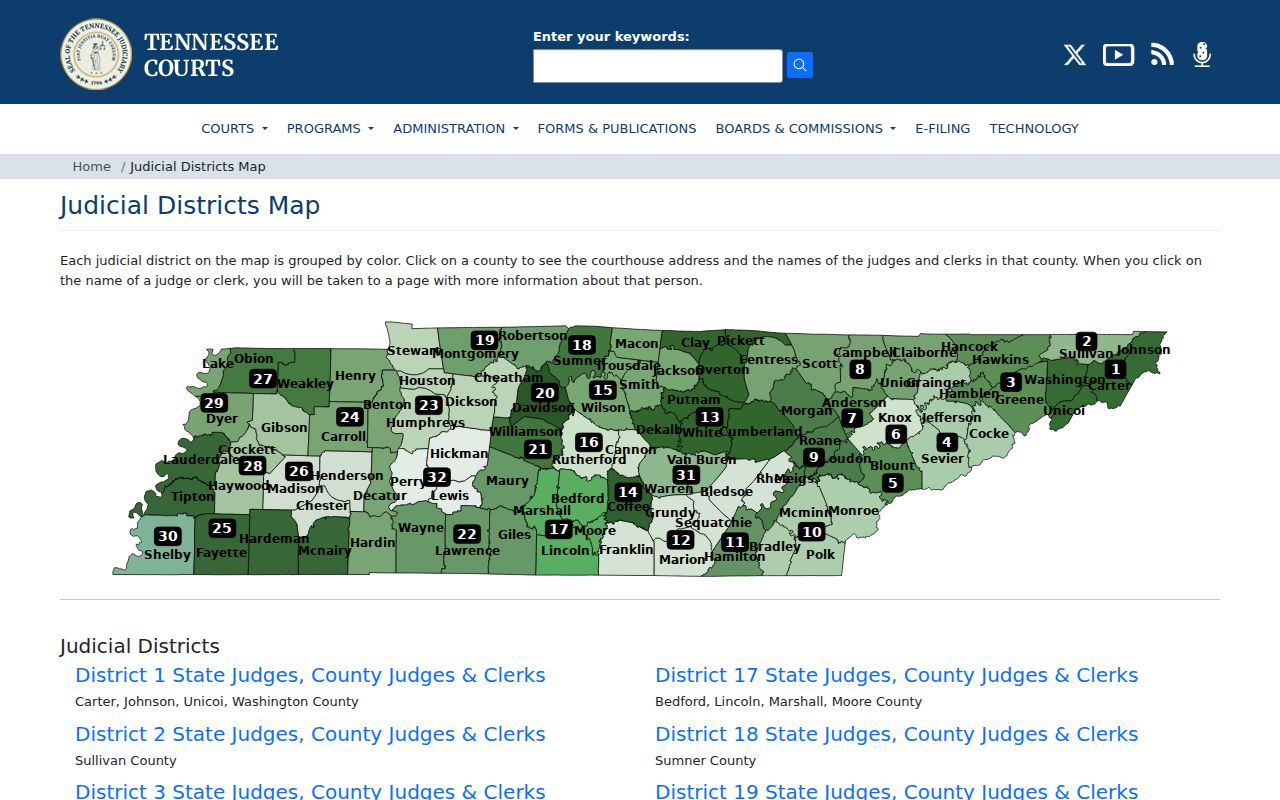
The district view helps separate regional judicial assignments from the local clerk office that holds each Sevier County case record.
Sevier County Court Case Channels
The correct counter depends on the case. Circuit Court Clerk Karen Atchley maintains Circuit/Criminal felony and court-of-record files at 125 Court Square, Suite 207E, Sevierville, TN 37862. The office can be reached at 865-453-5536 or katchley@seviercountytn.org. General Sessions Clerk Penny Johnson handles Sessions criminal, misdemeanor, traffic, warrant, and preliminary records at 127 Commerce Street, Room 1103, Sevierville, TN 37862, with 865-453-6116 and pjohnson@seviercountytn.org as published contacts.
Municipal records remain with the issuing city court. The Tennessee municipal clerk directory helps confirm the right office. Sevierville City Court uses 300 Gary Wade Boulevard and 865-868-1759. Pigeon Forge City Court lists 225 Pine Mountain Road and 865-429-7410. Gatlinburg City Court lists 1230 Parkway East, Suite 2 and 865-436-1419. Begin with the city clerk for an ordinance or city traffic citation, then ask whether related criminal proceedings moved to Sevier County General Sessions.
The official directory makes the city and county split visible before a request is sent. View Tennessee's municipal court clerk directory.
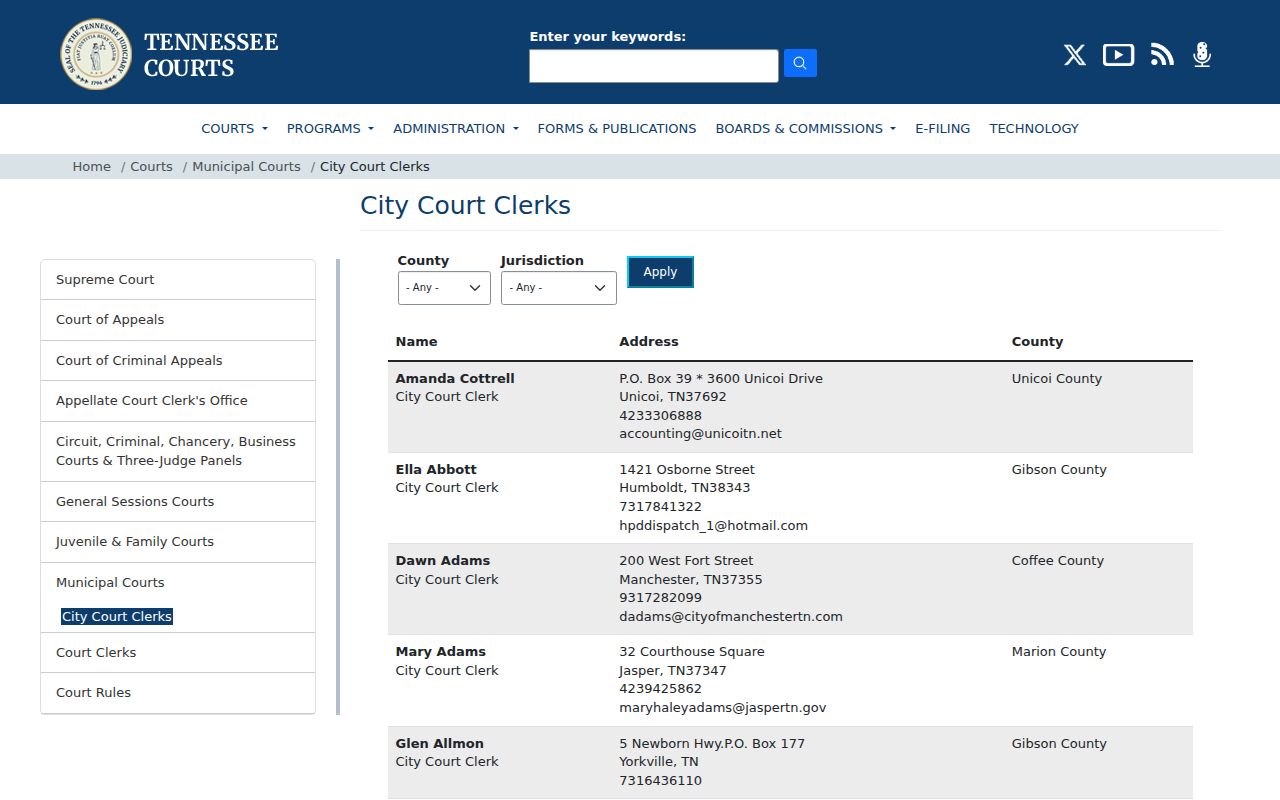
That distinction prevents a Sevierville, Pigeon Forge, or Gatlinburg citation search from being mistaken for a complete county criminal case search.
How to Search Case Records
No comprehensive public trial docket covers every Sevier County court. Start with the likely clerk and give a full name, an approximate filing or arrest date, and a case number when known. Ask whether the matter began in Sessions, received a new number after indictment, or remains a municipal case. The following sequence preserves those distinctions.
- Identify the court from a citation, bond paper, charging document, or hearing notice. If that is unclear, call General Sessions first.
- Provide the full name and filing or arrest date. Offer a date of birth only if the clerk accepts it for matching.
- Ask whether grand-jury action created a new Circuit/Criminal case number and whether both files should be checked.
- Review the public docket and request the charging paper, disposition, judgment, or other available document needed to answer the question.
- Confirm current copy and certification charges, archive retrieval time, and the method for receiving or inspecting the record.
For an appeal, use the Tennessee appellate opinion search. Its fields are useful for locating the appealed subset, not for proving that no trial case exists.
| Field Label | Type | Required | Notes |
|---|---|---|---|
| Court | Dropdown | No | Limits the appellate court |
| County | Dropdown | No | Select Sevier |
| Authoring or Originating Judge | Text | No | Search either judicial role |
| From Date / To Date | Date | No | Limits the filed-date range |
| Case Number or Name | Text | No | Use an appellate number or style keywords |
| Keyword | Text | No | Searches case summary or opinion text |
| Dispositive Order | Dropdown | No | Filters the type of order |
Sevier County Case Numbers Can Change
A common mistake is searching one number across every court. A felony arrest may produce a General Sessions file for the warrant, first appearance, and preliminary steps. An indictment or presentment can then create a Circuit/Criminal Court case with a different number. The two records describe connected stages, but each clerk controls its own file. Ask the Sessions clerk whether the matter advanced and ask the Circuit clerk to search the later filing.
Names alone can also mislead, especially when spelling varies or a name is common. Compare the court, offense date, case number, and any age or birth information the clerk can lawfully use. A TORIS entry may summarize a fingerprint-linked arrest cycle, but the Sevier County criminal court judgment controls the local disposition. For broader context on how those sources fit together, see the Sevier County criminal history overview.
Note: A missing Sessions result may mean the case moved, not that Sevier County criminal charges never existed.
What the Case File Shows
A Sevier County case file centers on one prosecution. Its public portions can establish which charge was filed, when hearings occurred, how a plea or trial ended, and what sentence the judge imposed. The docket is an event list. The underlying orders and judgment supply the details. Confidential identifiers, protected victim information, and sealed material may be removed from public copies.
| Case Number & Court | Identifies the clerk, division, and specific prosecution. |
|---|---|
| Charging Document | Shows the complaint, indictment, presentment, or other filed accusation. |
| Docket Entries | Lists filings, hearings, motions, orders, and procedural events. |
| Hearing Dates | Tracks scheduled and completed court appearances. |
| Disposition & Judgment | States the outcome for each filed charge, such as conviction, dismissal, acquittal, or nolle prosequi. |
| Sentence & Conditions | Records confinement, probation, costs, restitution, or other ordered terms when applicable. |
A disposition is the outcome of a charge. Nolle prosequi means the prosecutor formally chose not to proceed at that time. Neither term should be inferred from a booking page.
Sevier County Appellate Case Records
The appellate opinion database can reveal a Sevier County trial number, the originating judge, the issues reviewed, procedural history, rulings, and the appellate judgment. Results commonly provide the case style, case number, county, court, filed date, summary, and a free opinion PDF. It is a strong research channel when a case reached an appellate court.
The official opinion search interface shows the filters captured in the table above.
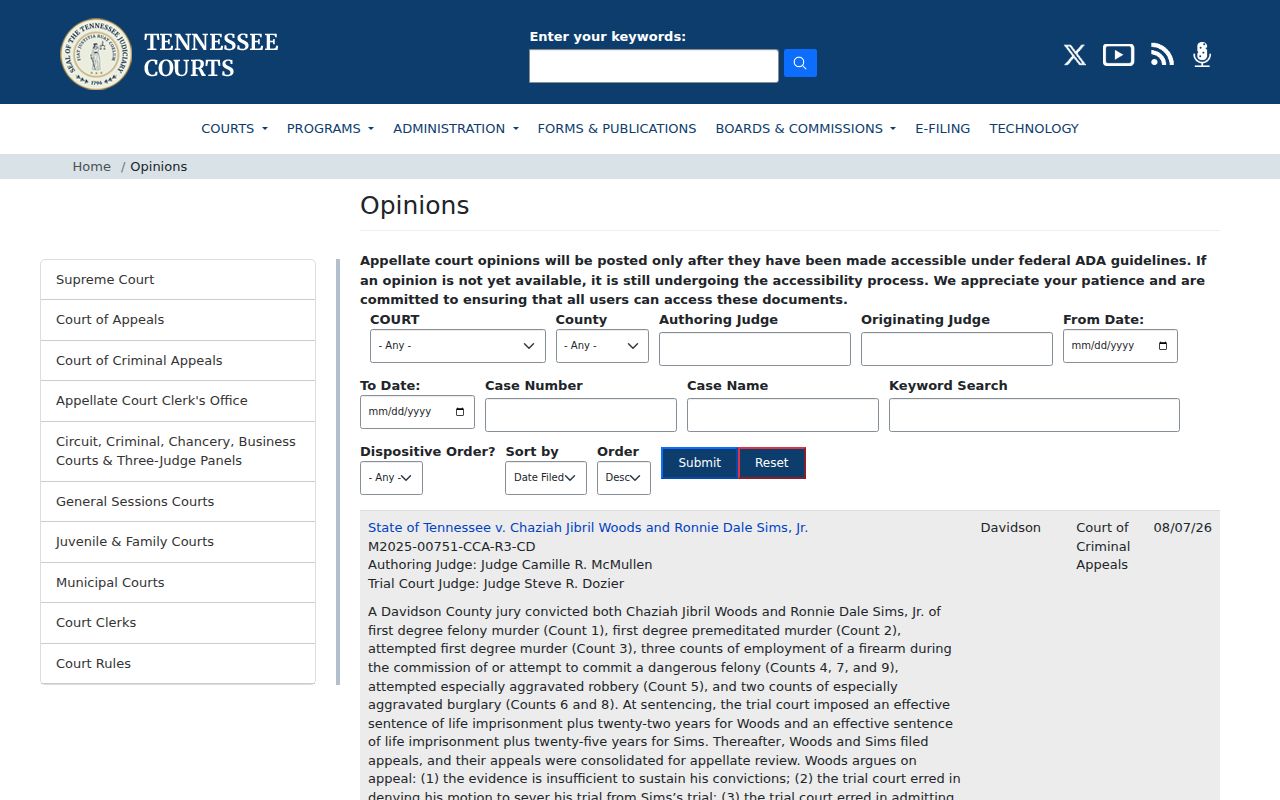
An empty appellate search proves only that no matching published appeal was found. It says nothing conclusive about the Sevier County trial docket.
Stages of a Criminal Case
A local criminal matter can start with an arrest warrant, citation, or complaint. General Sessions handles early process and preliminary review. A felony that moves forward may reach the grand jury, then Circuit/Criminal Court through an indictment or presentment. Plea talks, motions, and hearings follow. A plea or trial produces a disposition, and a conviction leads to sentencing. Appeals form a later and separate record layer.
Case flow: Charges Filed → Arraignment → Pretrial → Plea or Trial → Disposition → Sentencing
Arraignment is the hearing where the accused is told the charges and enters a plea. A disposition is the result for each charge. A sentence states the court-ordered consequence after a conviction. Keeping those fields separate prevents a pending accusation from being read as a final judgment.
Sevier County Criminal Filing Context
The official FY2024-25 report counted 3,484 Sevier Circuit criminal filings. Probation violations led the listed groups with 671 filings, followed by 563 drug cases, 501 other motor-vehicle cases, 369 DUI matters, 290 burglary or theft filings, and 221 assault filings. These totals measure workload entries. They are not unique people, arrests, or convictions, and one case may not map neatly to one incident.
The volume helps explain why a precise case number and the correct court level matter. It also shows why docket terms must be read in context. A probation-violation filing, for example, records an allegation and court process. It does not by itself prove that supervision was revoked.
Tennessee added a fifth Fourth District circuit judgeship, and Jeremy Ball was appointed in January 2025 before immediately presiding over drug recovery court. The AOC then released a statewide trial case-management and eFiling request for proposals in June 2025. Those changes signal court growth and planned modernization, but present access still depends on Sevier County clerks. The official trial judge directory reflects the courts serving the district.
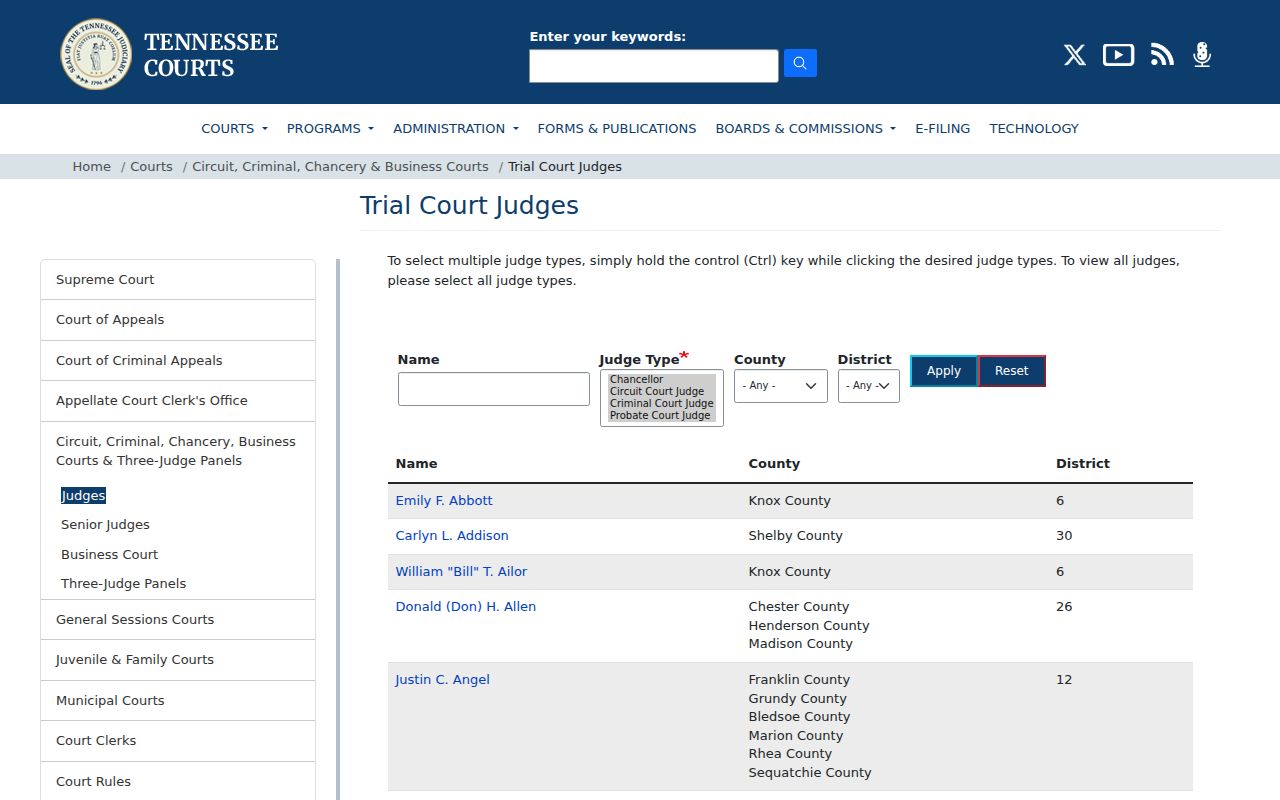
Use that directory to identify the court structure, while the Sevier clerk remains the source for the actual local file.
Archived Sevier County Case Files
Older Sevier County criminal records may be stored offsite, on paper, or in a scanned system not exposed online. Ask the clerk whether the file is onsite, archived, or digitized. Also ask how long retrieval takes, whether public-terminal inspection is free, and what current per-page or certification charges apply. The county research did not establish a universal copy fee, so no single amount should be assumed.
Bring the case number when possible. If it is missing, supply the full name and an approximate date range. For a matter that moved from Sessions to Circuit, request both numbers and check both files. A certified disposition is usually more useful than a bare docket when the goal is to confirm how each charge ended.
Access & Restrictions
Tennessee court records are generally open unless a law, rule, or court order limits access. The Tennessee Public Records Act, principally T.C.A. §§10-7-503 through 10-7-505, governs many state and local records. Tennessee Supreme Court Rule 34 addresses court-record access and redaction. Begin with the custodian and a focused request rather than expecting one law to expose every document.
Juvenile files are generally confidential under T.C.A. §37-1-153. Expunged matters, sealed documents, medical information, protected victim data, and private identifiers may also be withheld or redacted. A public docket can remain visible while a protected item inside the file is unavailable. If a Sevier County criminal case does not appear, ask the clerk whether the court, spelling, date, archive status, or access restriction explains the gap.